Plain Language Rules for AI Writing
In this article
Plain language rules for AI writing are limits that you set before the AI tool writes a draft. Limit each sentence to 20 words. Ask for active voice. Use one name for each thing.
Short, plain sentences are easier for people to read. AI search tools also seem to quote them more often. This post gives you our five rules and a prompt block to copy.
Why do AI drafts need plain language rules?
AI tools tend to write long sentences. The draft looks polished, so the length is easy to miss. Your reader will not miss it.
Dense text shuts out many readers. A 2023 federal survey measured the reading skills of adults. 28% of U.S. adults scored at the lowest literacy levels. That share was 19% in 2017.
Accessibility standards agree. The W3C’s guidelines flag text that needs more than nine years of school to read. That rule is in the strictest tier, so most sites do not have to meet it. It is still a good target.
What is ASD-STE100?
ASD-STE100 is a set of writing rules and an approved word list. Its other name is Simplified Technical English (STE). STE started in the early 1980s for aircraft maintenance manuals. It helps readers who learned English as a second language to follow each step.
The STE rules use numbers. That makes them easy to give to an AI tool. A sentence in an instruction can have 20 words. A sentence in a description can have 25 words.
A paragraph can have six sentences. Instructions use active voice.
Which STE rules work for a blog post?
STE was written for manuals. A blog post needs a human voice. So we use about 80% of STE, and we do not use the word list.
We give the AI tool five rules.
- Keep each sentence short. Use 20 words or fewer.
- Put one idea in each sentence. Split a sentence that has two ideas.
- Use active voice. Say who does the action.
- Use one name for each thing. Do not change the name for variety.
- Keep each paragraph short. Use four sentences or fewer.
Rule 4 is more important than it looks. Think of a post that says “chatbot,” “virtual agent,” and “assistant.” The reader must guess if these are three things or one thing.
Is a 10-word sentence limit too strict?
Yes, if you apply the limit to every sentence. Text with only very short sentences reads like a telegram. An idea that needs a “because” gets cut in two.
Use about 10 words as your average. Use 20 words as your limit. STE allows 20 to 25.
This post follows the same rules. Its sentences average about 8 words. Only the “before” example below has more than 20 words.
What does a plain language rewrite look like?
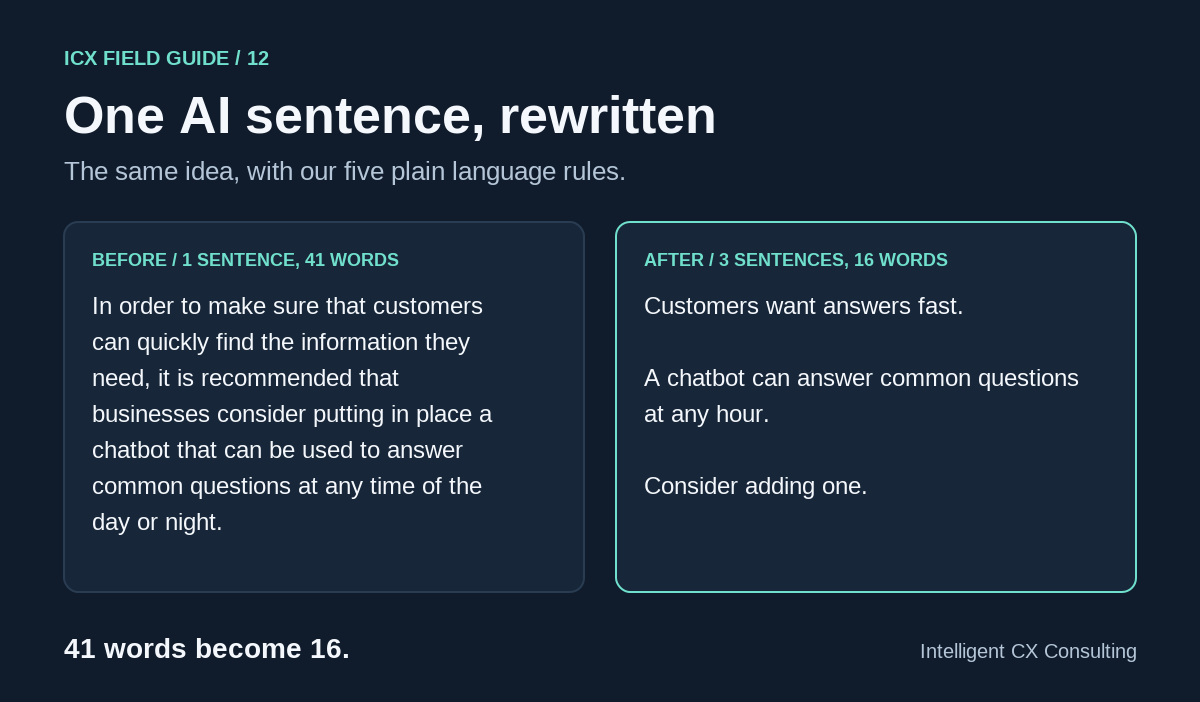
Here is one sentence from a typical AI draft. It has 41 words.
Before: In order to make sure that customers can quickly find the information they need, it is recommended that businesses consider putting in place a chatbot that can be used to answer common questions at any time of the day or night.
Here is the same idea with the five rules.
After: Customers want answers fast. A chatbot can answer common questions at any hour. Consider adding one.

The rewrite has 16 words in three sentences. The reader gets the same idea in fewer than half the words.
Do short sentences help with AI search?
The early evidence says yes, but the evidence has limits. In May 2026, OrganiKPI studied 11,346 passages that Google’s Gemini quoted from web pages. The median passage had 10 words. The longest passage had 18 words.

Read those numbers with care. A search agency did the study, and the study covers one AI tool. A passage can also be a clipped part of a longer sentence.
Academic research agrees. A 2024 paper from researchers at Princeton and IIT Delhi tested page edits for AI answers. Edits for smoother, clearer text raised a page’s visibility score from 19.3 to 24.7, or about 28%. The test used an older AI model, so treat the number as a signal.
Google is more careful. Google’s guide for site owners says that you do not need a special writing style for generative AI search. The guide says to write for your human audience and to use clear headings. We agree: write for the reader first, and count AI citations as a bonus.
How do you give plain language rules to an AI tool?
Set the rules before the draft. Do these five steps.
- Paste the five rules. Put them at the top of your prompt, before the topic.
- Ask for the draft. Name the topic and the reader.
- Ask for a check. Tell the AI tool to list each sentence that has more than 20 words.
- Count some sentences yourself. Count the words in five sentences. An AI tool can count words wrong.
- Check the reading level. Use a readability checker. Aim for grade 8 or lower.
Here is the prompt block that we use. Copy it into any AI tool before you name the topic.
Follow these rules in every sentence.
1. Use 20 words or fewer in each sentence.
2. Put one idea in each sentence.
3. Use active voice.
4. Use one name for each thing. Do not use synonyms.
5. Use four sentences or fewer in each paragraph.
After the draft, list each sentence that breaks rule 1.
What do plain language rules not fix?
Short sentences do not make a draft true. An AI tool can write a false fact in eight plain words. Check the facts and the sources yourself. Then score the draft with our AI writing QA scorecard.
Our post on how to QA AI writing without code shows how to build the rubric.
The rules can also make your voice flat. Read the draft aloud. Where the draft sounds choppy, join two sentences. That review is what a content writer does now.
Do you want these rules in your team’s AI tools? Tell us which AI tools your team uses. We’ll help you set up the rules.
FAQ
What are plain language rules for AI writing? They are limits that you give an AI tool before it writes a draft. Common rules are a sentence limit, active voice, and one name for each thing.
What is the ASD-STE100 sentence limit? The limit is 20 words for a sentence in an instruction. It is 25 words for a sentence in a description. A paragraph can have six sentences.
Must every sentence have 10 words or fewer? No. Use about 10 words as your average. Use 20 words as your limit. A limit of 10 words for every sentence makes the text choppy.
Do short sentences help a page appear in AI answers? Early evidence says that they help. In one 2026 study, the median passage that Gemini quoted had 10 words. Google’s guide says to write for people first.
What reading level is right for a business blog? Aim for grade 8 or lower. The W3C’s guidelines flag text that needs more than nine years of school to read.
Frequently asked questions
What are plain language rules for AI writing?
They are limits that you give an AI tool before it writes a draft. Common rules are a sentence limit, active voice, and one name for each thing.
What is the ASD-STE100 sentence limit?
The limit is 20 words for a sentence in an instruction. It is 25 words for a sentence in a description. A paragraph can have six sentences.
Must every sentence have 10 words or fewer?
No. Use about 10 words as your average. Use 20 words as your limit. A limit of 10 words for every sentence makes the text choppy.
Do short sentences help a page appear in AI answers?
Early evidence says that they help. In one 2026 study, the median passage that Gemini quoted had 10 words. Google's guide says to write for people first.
What reading level is right for a business blog?
Aim for grade 8 or lower. The W3C's guidelines flag text that needs more than nine years of school to read.
Get an email when we publish a new post.