Enterprise AISeptember 28, 20268 min read

Is Dialogflow CX, Azure AI, or Bedrock Right for You?

ICX compares Dialogflow CX (now Conversational Agents), Azure AI Foundry Agent Service, and Amazon Bedrock AgentCore for service agents using a five-question framework: where logic lives, how escalation works, how guardrails attach, what the team must already run, and how fast the product renames. Each platform favors a different starting point, and none is a drop-in replacement for conversation design.
Industry TrendsJuly 28, 20268 min read

The AI Engineering Maturity Model (Five Names From Prompts to Graphs)

The AI industry has named five engineering terms in four years. Prompt engineering came in 2022, context engineering in June 2025, then harness, loop, and graph engineering through 2026. The layers of work are real. Some of the names are marketing. Context engineering has frontier-lab backing. Harness engineering is gaining credible adoption. The two newest terms are still contested. A business leader should map problems to layers, not chase job titles.

AI OperationsJune 26, 202614 min read

How Should CX Leaders Evaluate AI Agents Before Customers Do?

Sample-based quality review was built for a few human agents handling a few hundred calls a day. It cannot keep up with a fleet of AI agents handling thousands. Modern AI agent evaluation is continuous, rubric-driven, and tied directly into deployment gates. CX leaders who build it now will catch failures before customers do. Those who keep sampling will find their failures on social media.

Enterprise AIJune 24, 202615 min read

Claude Tag, MCP Authorization, and Sandboxes in Anthropic's June 2026 Enterprise Stack

Anthropic shipped three pieces of enterprise AI infrastructure between May and June 2026. Claude Tag puts a persistent agent inside Slack. Enterprise-Managed Authorization provisions MCP connectors through Okta. Self-hosted sandboxes keep agent execution inside the customer perimeter. Together they reframe AI from a chat tool into a governed teammate with identity, scope, and a full audit trail.

AI StrategyJune 21, 202618 min read

Why Context Engineering Is the Infrastructure Enterprise AI Has Been Missing

Context engineering is the discipline of designing what information an AI system receives, how it is structured, and when it enters the model's working memory. Gartner named it the breakout AI capability of 2026 and predicts context improvements will enhance agentic AI accuracy by 30%. For CX leaders, context architecture determines whether AI investments deliver customer trust or operational failure.

Industry TrendsJune 19, 202614 min read

Anthropic's $1.5B Move From Model Maker to Consultant

Anthropic launched a $1.5B enterprise AI services firm with Blackstone, Hellman & Friedman, and Goldman Sachs in May 2026 to embed engineers inside companies and redesign workflows around Claude. For CX leaders, the move carries a specific message. The AI bottleneck has moved from model capability to deployment expertise. The new firm covers technical integration. It does not cover conversation design, content engineering, or experience measurement: the layers that determine whether an AI deployment improves customer experience or degrades it.

AI GovernanceJune 18, 202616 min read

The AI Control Gap and Why Leaders Answer for AI They Can't Control

Two-thirds of CIOs and CTOs are accountable for AI systems they don't fully control, per a June 2026 IBM study of 2,000 executives. Seventy percent say business teams deploy AI faster than IT can track. Organizations embedding control deploy 16 times more agents with 25 percent fewer incidents than those relying on manual governance. The AI Control Gap is structural and solvable, but only by treating governance as a deployment prerequisite, not a follow-on project.

Industry TrendsJune 18, 202612 min read

ISO 42001 and AI Agent Readiness for Scaling Enterprise AI

Buying AI tools is not the same as being ready for AI agents. Most organizations stall somewhere between pilot and scale, not because the technology failed, but because governance, data, and measurement weren't in place before deployment. Only 21 percent of enterprises have mature agentic AI governance while 42 percent are already running it in production. That gap is where CX programs break down.

Industry TrendsApril 24, 20268 min read

An ICX Perspective on the Next 12 Months in AI Customer Experience

Five shifts will define AI customer experience over the next 12 months. The chatbot-to-agent transition accelerates. Conversation design becomes a real discipline with explicit owners. Regulation lands at the CX layer with the EU AI Act in August 2026. AI copilots outperform full automation in enterprise CX. Measurement matures from containment to resolution. Teams that ignore any of the five fall behind.

Industry TrendsApril 16, 20267 min read

Why AI Agents Are Replacing Chatbots in CX

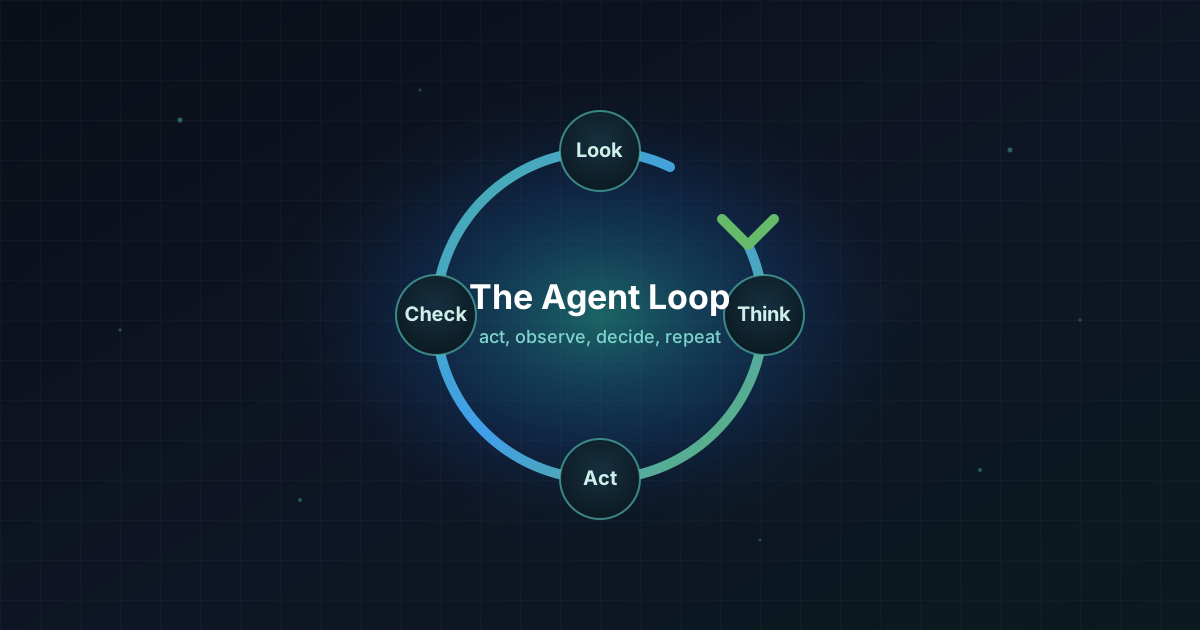
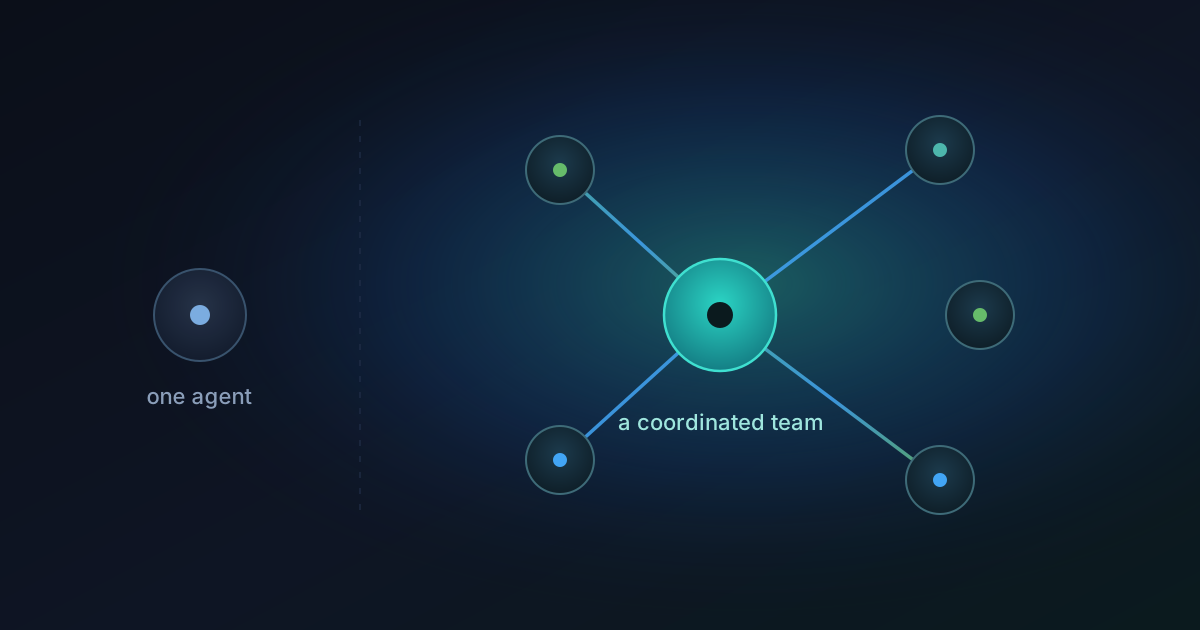
AI agents are displacing chatbots in enterprise customer experience faster than most teams forecasted. The difference is not the chat window. It is what happens underneath. Chatbots classify and route. Agents plan, decide, and close. The transition exposes three failure patterns most teams hit: treating an agent like a smarter chatbot, skipping the orchestration layer, and underestimating the measurement gap.

CX StrategyApril 15, 20268 min read

Stop Buying AI Tools. Start Designing AI Experiences.

The AI tools market grows every quarter. Enterprise results stay flat. The missing piece is not another tool. It is experience design: the language, escalation paths, measurement framework, and explicit ownership that turn a tool into a working customer experience. The platform is a vehicle. The destination is the experience. Most organizations have invested heavily in the vehicle and ignored the destination.

Conversational AIApril 11, 20269 min read

The 5 Conversational Patterns That Make Users Rage-Quit Your Chatbot

Five conversational patterns cause users to rage-quit chatbots: the dead-end response (no path forward), false confidence (sounds sure but wrong), context blindness (forgets what was said two turns ago), hostile politeness (over-formal refusals), and circular escalation (asks for the same info repeatedly). Each pattern shows up in support data and is fixable in conversation design, not in the model.

Conversational AIApril 1, 20268 min read

How Your AI Should Handle an Angry Customer (Hint: Not Like a Human Would)

When customers are angry, AI that mimics human empathy often makes things worse. 'I understand your frustration' from a chatbot reads as performative and slows down the resolution. The better pattern: acknowledge the situation briefly, name the next concrete step, and remove obstacles. Four emotional moments deserve specific design: high frustration, fear, urgency, and grief.

Industry TrendsMarch 5, 20267 min read

Why AI Transparency Means Disclosing How Your Business Uses AI

AI transparency means clearly telling customers when AI is involved in writing, answering, recommending, or deciding. Most businesses deploying AI never disclose it. That silence is not a strategy. It is a liability. The EU AI Act will require it from August 2026. Anthropic's usage policy already sets the bar. Customer trust depends on disclosure, and the business case is clearer than most teams realize.

Want to work with ICX on your AI project?

ICX builds conversational AI experiences your customers will actually use.

Get in touch