What Is Loop Engineering and Why Should You Learn It Now?
 By Christi AkinwumiJune 27, 2026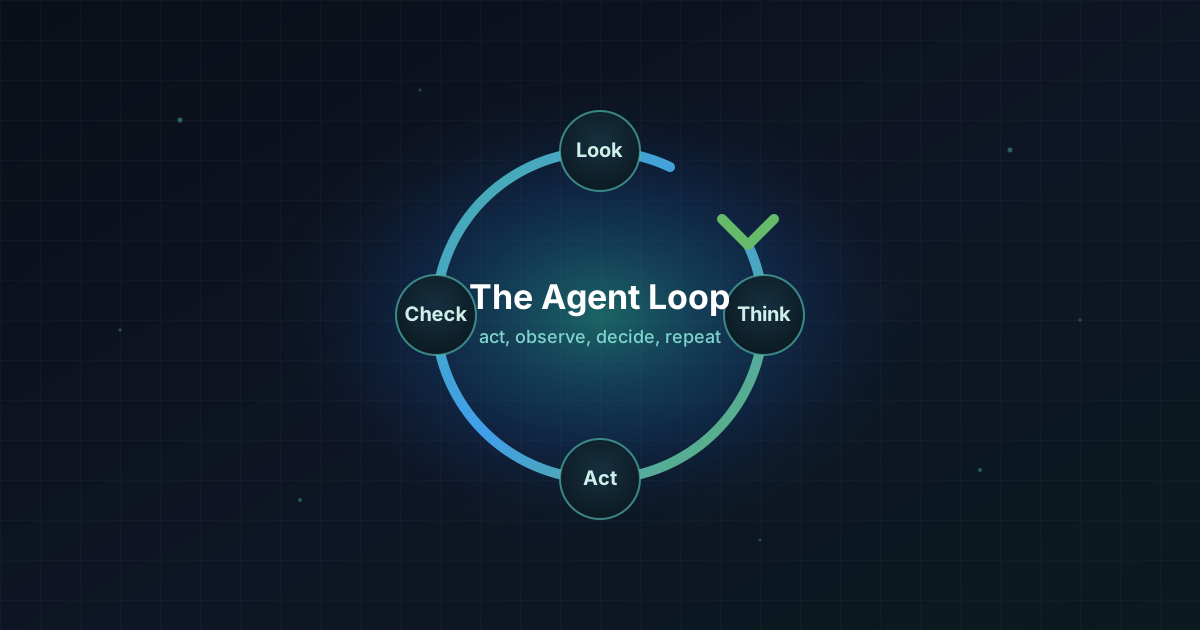
In this article
Here is a small thing that quietly changed everything about working with AI.
For two years, the main skill people learned was how to ask. You wrote a clever prompt, you got an answer, and if the answer was wrong you asked again. You were the loop. You read the output, you noticed the mistake, you fixed the prompt, you tried once more.
Now the machine does that part too.
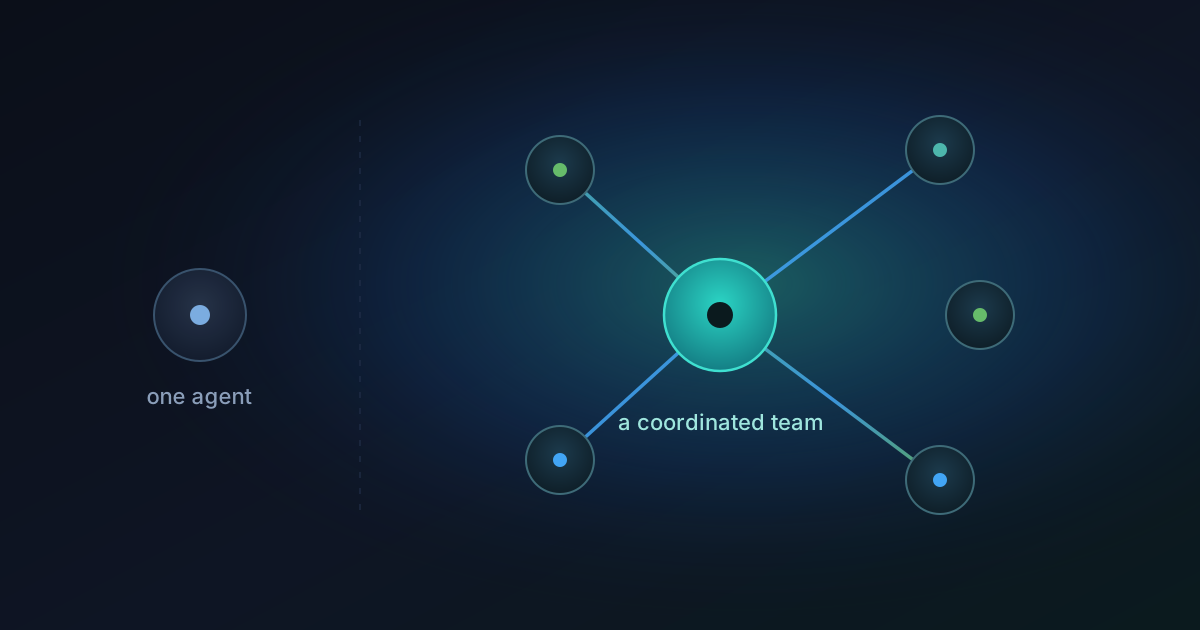
Today’s best AI systems do not stop after one answer. They take an action, look at what happened, decide what to do next, and repeat. They keep going until the job is actually done. The skill of designing that cycle has a name. People call it loop engineering, and it is fast becoming one of the most valuable things you can learn if you want to get into AI.
If prompt engineering was about writing the perfect question, loop engineering is about building a worker that keeps working. This guide explains what that means in plain words, shows you where it already lives in real products, and points to the jobs it is creating right now.
What Changed When AI Started to Loop
For most of 2023 and 2024, using AI felt like a vending machine. You put in a request. You got one item out. If it was wrong, you put in another request.
The shift is simple to say and large in effect. The AI now holds the request, works on it across many small steps, checks its own progress, and only stops when it reaches the goal or hits a limit you set.
Anthropic draws a clean line here. In its widely cited guide Building Effective Agents, it separates two things. A workflow follows a fixed set of steps you wrote in advance. An agent decides its own steps. As Anthropic puts it, agents “use tools based on environmental feedback in a loop.” That last word is the whole idea. The agent acts, the world responds, and the response shapes the next move.
This is not brand new science. The pattern goes back to a 2022 research paper called ReAct: Synergizing Reasoning and Acting in Language Models. The authors showed that a model does better when it switches between thinking and doing, instead of only thinking or only doing. Reasoning helps the model plan and catch its own errors. Acting lets it pull in fresh facts from tools and the world. That back and forth is the seed of every agent loop you see today.
What is new in 2026 is that the loop now works on open-ended, real jobs. As Oracle explains in its overview of the AI agent loop, every major lab, including OpenAI, Anthropic, Google, and Microsoft, has settled on the same core cycle even while building very different products on top of it.
The Agent Loop in Plain Words
Strip away the jargon and an agent loop has four moves that repeat.
- Look. The agent takes in the current situation: your goal, the last tool result, an error message, or new data.
- Think. It reasons about what that means and what to do next.
- Act. It does something real: runs code, searches the web, queries a database, writes a file, or hands work to another agent.
- Check. It looks at the result. If the goal is met, it stops. If not, the result becomes the new starting point, and the loop runs again.
That is the entire machine. The power comes from repetition. One pass might fix one bug. Twenty passes can fix a whole feature.
The data science education group Data Science Dojo traces this evolution from the ReAct pattern to modern practice in its guide to agentic loops. The short version is that the loop got more reliable, and people started treating its design as a craft worth naming.
So What Exactly Is Loop Engineering
Here is a plain definition you can keep.
Loop engineering is the practice of designing AI agents that act, observe the result, decide what to do next, and repeat until a real goal is met.
It is not one trick. It is a set of decisions you make on purpose. The teams at MindStudio describe loop engineering as designing, specifying, and maintaining these loops, which usually means four jobs:
- Define a goal the agent can actually check. “Make the tests pass” is checkable. “Make it good” is not.
- Decide how the loop starts. A person clicks a button, a new email arrives, or a schedule fires.
- Pick the loop’s shape. Some tasks need one simple loop. Others need a loop that checks its own work, which Anthropic calls the evaluator-optimizer pattern, where one part generates and another part grades and sends feedback.
- Build the guardrails. Set a step limit, a spending cap, and rules for when to stop or ask a human.
Notice that only one of those four jobs is about the AI model. The other three are about goals, triggers, and limits. That is good news if you are trying to break in. A lot of loop engineering is clear thinking, not deep math.
Real Examples You Have Probably Already Seen
This stops being abstract the moment you watch it work.
A coding assistant that fixes itself. Ask a modern coding agent to add a feature. It writes the code, runs the tests, reads the failures, edits the code, and runs the tests again. It repeats until the tests pass. You did not prompt it at each step. The test result was the feedback that drove the loop. Anthropic’s own write-up on effective harnesses for long-running agents is all about keeping this kind of loop stable over long tasks.
A customer support agent that resolves a refund. A good support agent does not just reply. It reads the message, looks up the order, checks the refund policy, confirms the customer qualifies, drafts the refund, and verifies the amount before sending. Each step depends on the last. If the order lookup fails, the loop reasons about why and tries another path. This is the kind of work we help clients design at ICX Consulting, and it lives or dies on the loop, not the chat window.
A research helper that digs. Give it a question. It searches, reads the top sources, notices that one claim is not backed up, searches again for that specific gap, and only then writes the answer. The “notice a gap and search again” move is the loop catching its own weak spot.
A personal example you can build. Imagine a job-hunt helper. You give it a job post and your resume. It drafts a cover letter, compares the draft against the exact words in the job post, finds three requirements you did not address, rewrites to cover them, and checks again. That is a loop with a checkable goal. It is also a realistic first project for a beginner.
The pattern across all four is the same. There is a clear goal, a way to check progress, and a cycle that runs until the check passes.
Why Leaders and Newcomers Should Both Care
For a newcomer, loop engineering is where the demand is heading. Job postings that mention agentic AI skills have climbed sharply, and OpenAI now publishes a practical guide to building agents aimed at product and engineering teams who are hiring for exactly this. The skill is young enough that you can learn it before it becomes crowded.
For a leader, the reason to care is risk and reward sitting side by side. An agent that loops can finish real work without a person babysitting each step. That is the reward. The risk is that a loop with no limits can repeat a mistake at machine speed or spend real money on every pass. Microsoft’s 2026 Work Trend Index frames the year ahead around agents plus human agency, not agents alone. The loop is where that balance is set.
Five Insights To Carry With You
These are the points that separate someone who has heard of loop engineering from someone who can do it.
Insight one: the goal must be checkable, or the loop never knows when to stop. The single most common failure is a fuzzy goal. “Improve the report” gives the agent no finish line. “Cut the report to one page and keep every number” does. The clearer your stopping test, the better your agent behaves. The ReAct paper showed this early: acting only helps when the agent can observe a result and judge it.
Insight two: feedback quality matters more than model size. An agent learns inside the loop from what it observes. If your tools return vague results, the agent reasons on fog. Anthropic’s guide on writing tools for agents makes this point well. Clear tool outputs make a smaller model act smart. Vague outputs make a large model act lost.
Insight three: start simple, then add only what you need. Anthropic’s main advice in Building Effective Agents is to reach for the simplest design first and add agent complexity only when a simpler path falls short. Many problems that look like they need a fancy multi-step agent are solved by one good prompt plus one tool. Loop engineering includes knowing when not to build a loop.
Insight four: guardrails are part of the design, not an afterthought. Data Science Dojo’s loop engineering design patterns treat limits as first-class parts of the loop. Set a maximum number of steps. Set a budget. Add a confidence check so the agent pauses when it is unsure. These rules are what keep a helpful loop from becoming an expensive one.
Insight five: the human checkpoint is a design choice, and sometimes a legal one. You decide where a person must approve before the agent acts. For high-impact actions, that approval is not optional. Article 14 of the EU AI Act requires that high-risk AI systems be designed so people can effectively oversee them. The United States NIST AI Risk Management Framework treats human oversight as part of trustworthy AI. Knowing where to place the human is a core loop engineering skill.
The New Jobs This Is Creating
If you are trying to pivot into AI, this is the part to read twice. Loop engineering is opening doors for people who are not all coders.
- Agent designers define goals, triggers, and stopping rules. This is close to product thinking.
- Conversation designers shape how an agent talks, asks for missing details, and hands off to a person. The craft of conversation design maps directly onto agent loops, because every loop needs clear language at its edges.
- Evaluation specialists build the checks that tell a loop whether it succeeded. This work rewards careful, skeptical thinkers.
- AI governance and oversight roles decide where humans approve actions and how the system stays accountable.
- Content engineers prepare the knowledge an agent reads inside its loop, so the agent acts on clean, current information instead of stale text.
You do not need every skill at once. Pick the entry point that matches who you already are. A writer can start with conversation design. An analyst can start with evaluation. A careful planner can start with goals and guardrails. From there, you grow into the rest.
What To Do Now, and What To Stop
If you want to get into AI through this door, here is a short plan.
Start by building one small loop end to end. Use the job-hunt helper idea or anything with a checkable goal. Watch where it gets stuck. That single project will teach you more than ten articles.
Learn to write a goal the agent can test. Practice turning “make it better” into a clear finish line. This habit is the heart of the work.
Read one primary source slowly. Anthropic’s Building Effective Agents and OpenAI’s practical guide to building agents are short, free, and written by the people building the tools.
Stop chasing prompt tricks as the main skill. One clever prompt is still useful, but it is no longer the frontier. The value has moved to the loop around the prompt.
Stop building loops without limits. Before you run any agent that acts on its own, decide the maximum steps, the budget, and the point where a human must say yes. Treat guardrails as part of the build, the same way you treat brakes as part of a car.
The people who will do well in AI over the next few years are not only the ones who can ask a model the perfect question. They are the ones who can hand a model a goal, design the cycle that gets it there, and know exactly where to put the human. That skill has a name now. It is worth learning while it is still early.
Key Takeaways
- Loop engineering is the practice of designing AI agents that act, observe, decide, and repeat until a real goal is met. It is the skill replacing one-shot prompting.
- Every agent loop has four moves: look, think, act, and check. The power comes from repeating them.
- A loop needs a goal it can actually check. A fuzzy goal means the agent never knows when to stop.
- Feedback quality beats model size. Clear tool outputs make a small model act smart.
- Guardrails are part of the design. Set step limits, budgets, and human approval points before you run an agent.
- The work is opening real jobs for non-coders too, including agent designers, conversation designers, evaluation specialists, and governance roles.
- Best first move: build one small loop with a checkable goal, then watch where it breaks.
Frequently Asked Questions
What is loop engineering in simple terms? Loop engineering is the practice of designing AI systems that do not just answer once. They take an action, look at the result, decide what to do next, and repeat that cycle until a clear goal is reached. It is the difference between asking an AI a single question and giving an AI a job to finish on its own.
What is an agentic loop? An agentic loop is the repeating cycle an AI agent runs to finish a task. At each turn the agent gathers context, reasons about what to do, takes an action such as calling a tool or running code, observes the outcome, and feeds that result into the next turn. The loop continues until the goal is met or a stopping rule fires.
How is loop engineering different from prompt engineering? Prompt engineering is about writing one strong instruction to get one strong answer. Loop engineering is about designing the whole cycle of action and feedback that lets an agent work toward a goal across many steps without a new prompt each time. Prompt engineering shapes a single reply. Loop engineering shapes ongoing behavior.
Do I need to be a programmer to learn loop engineering? Coding helps, but it is not the only path in. Loop engineering also needs people who can define clear goals, design safe stopping rules, write the instructions an agent follows, test agent behavior, and decide where a human must approve a step. Conversation designers, analysts, and operations people can all move into this work.
What are the risks of poorly designed agent loops? A loop with no limits can run forever, repeat the same mistake, or burn through money on API calls. It can also take a wrong action and then build every later step on that error. Good loop engineering adds guardrails such as step limits, cost caps, confidence checks, and human approval points for risky actions.
Where is loop engineering used in the real world today? It powers coding assistants that write code, run tests, read errors, and fix themselves. It powers customer support agents that look up an order, check policy, and draft a resolution. It powers research helpers that search, read, find gaps, and search again. Any task with a clear goal and a way to check progress can use it.
Sources
- Anthropic, Building Effective Agents
- Anthropic, Building Effective AI Agents eBook
- Anthropic, Effective Harnesses for Long-Running Agents
- Anthropic, Writing Effective Tools for AI Agents
- Yao et al., ReAct: Synergizing Reasoning and Acting in Language Models (arXiv:2210.03629)
- OpenAI, A Practical Guide to Building Agents (PDF)
- Oracle, What Is the AI Agent Loop?
- Data Science Dojo, Agentic Loops: From ReAct to Loop Engineering (2026 Guide)
- Data Science Dojo, 10 Loop Engineering Design Patterns for AI Builders
- MindStudio, What Is Loop Engineering? The New Meta for AI Coding Agents
- Microsoft, 2026 Work Trend Index: Agents, Human Agency, and Opportunity
- European Union, EU AI Act, Article 14: Human Oversight
- NIST, AI Risk Management Framework
Human Review & AI Assistance
This article was developed using AI-assisted research, analysis, and drafting workflows. A human reviewer evaluated the content before publication. Sources were reviewed for accuracy at the time of publication. While every effort has been made to ensure accuracy, readers should independently verify information before making business, legal, financial, regulatory, or technical decisions.
Frequently asked questions
What is loop engineering in simple terms?
Loop engineering is the practice of designing AI systems that do not just answer once. They take an action, look at the result, decide what to do next, and repeat that cycle until a clear goal is reached. It is the difference between asking an AI a single question and giving an AI a job to finish on its own.
What is an agentic loop?
An agentic loop is the repeating cycle an AI agent runs to finish a task. At each turn the agent gathers context, reasons about what to do, takes an action such as calling a tool or running code, observes the outcome, and feeds that result into the next turn. The loop continues until the goal is met or a stopping rule fires.
How is loop engineering different from prompt engineering?
Prompt engineering is about writing one strong instruction to get one strong answer. Loop engineering is about designing the whole cycle of action and feedback that lets an agent work toward a goal across many steps without a new prompt each time. Prompt engineering shapes a single reply. Loop engineering shapes ongoing behavior.
Do I need to be a programmer to learn loop engineering?
Coding helps, but it is not the only path in. Loop engineering also needs people who can define clear goals, design safe stopping rules, write the instructions an agent follows, test agent behavior, and decide where a human must approve a step. Conversation designers, analysts, and operations people can all move into this work.
What are the risks of poorly designed agent loops?
A loop with no limits can run forever, repeat the same mistake, or burn through money on API calls. It can also take a wrong action and then build every later step on that error. Good loop engineering adds guardrails such as step limits, cost caps, confidence checks, and human approval points for risky actions.
Where is loop engineering used in the real world today?
It powers coding assistants that write code, run tests, read the errors, and fix themselves. It powers customer support agents that look up an order, check policy, and draft a resolution. It powers research helpers that search, read, find gaps, and search again. Any task with a clear goal and a way to check progress can use it.
Get an email when we publish a new post.