A small enterprise team collaborates around a laptop in a modern office, representing AI teammates joining human workflows.
Enterprise AIJune 24, 202615 min read

Claude Tag, MCP Authorization, and Sandboxes in Anthropic's June 2026 Enterprise Stack

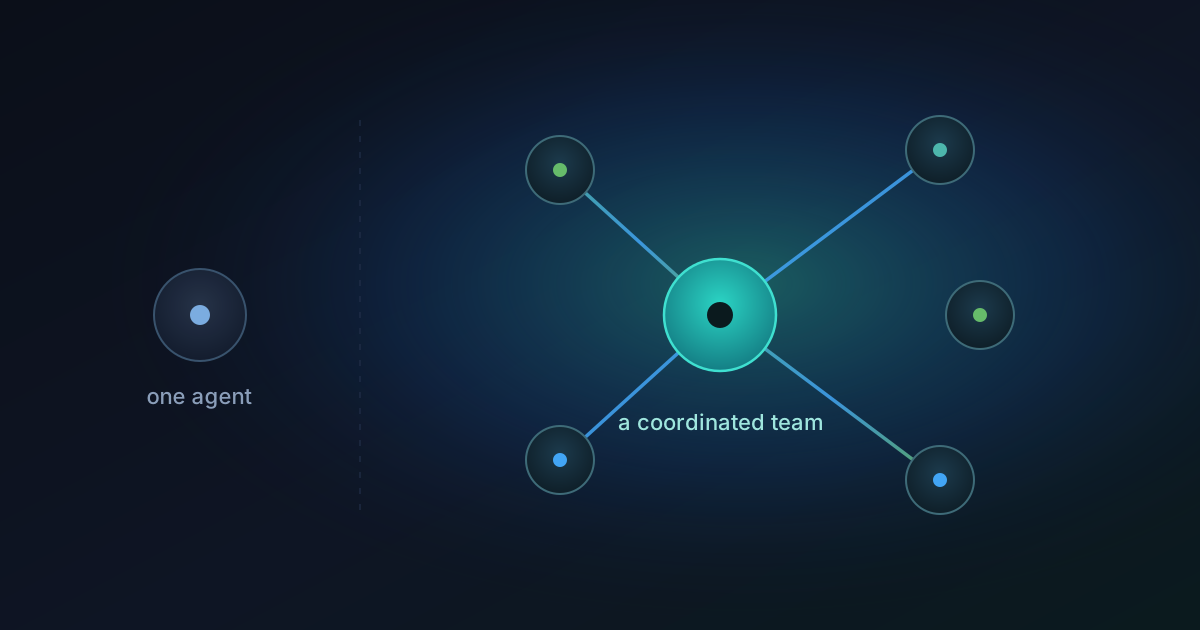
Anthropic shipped three pieces of enterprise AI infrastructure between May and June 2026. Claude Tag puts a persistent agent inside Slack. Enterprise-Managed Authorization provisions MCP connectors through Okta. Self-hosted sandboxes keep agent execution inside the customer perimeter. Together they reframe AI from a chat tool into a governed teammate with identity, scope, and a full audit trail.

Close-up of a circuit board, representing context engineering as the infrastructure layer for enterprise AI
AI StrategyJune 21, 202618 min read

Why Context Engineering Is the Infrastructure Enterprise AI Has Been Missing

Context engineering is the discipline of designing what information an AI system receives, how it is structured, and when it enters the model's working memory. Gartner named it the breakout AI capability of 2026 and predicts context improvements will enhance agentic AI accuracy by 30%. For CX leaders, context architecture determines whether AI investments deliver customer trust or operational failure.

Two people in a business meeting reviewing an AI strategy plan on a laptop, representing the convergence of model providers and consulting services in enterprise AI transformation
Industry TrendsJune 19, 202614 min read

Anthropic's $1.5B Move From Model Maker to Consultant

Anthropic launched a $1.5B enterprise AI services firm with Blackstone, Hellman & Friedman, and Goldman Sachs in May 2026 to embed engineers inside companies and redesign workflows around Claude. For CX leaders, the move carries a specific message. The AI bottleneck has moved from model capability to deployment expertise. The new firm covers technical integration. It does not cover conversation design, content engineering, or experience measurement: the layers that determine whether an AI deployment improves customer experience or degrades it.

Enterprise data dashboard showing multiple analytics panels, representing the visibility gap between AI deployment velocity and governance infrastructure
AI GovernanceJune 18, 202616 min read

The AI Control Gap and Why Leaders Answer for AI They Can't Control

Two-thirds of CIOs and CTOs are accountable for AI systems they don't fully control, per a June 2026 IBM study of 2,000 executives. Seventy percent say business teams deploy AI faster than IT can track. Organizations embedding control deploy 16 times more agents with 25 percent fewer incidents than those relying on manual governance. The AI Control Gap is structural and solvable, but only by treating governance as a deployment prerequisite, not a follow-on project.

Illustration of a glasswing butterfly with transparent wings over a dark grid, evoking the Project Glasswing security theme
Industry NewsMay 20, 20267 min read

Project Glasswing Is a Cybersecurity Story. A Conversation Designer Reads It Differently.

Project Glasswing is a new Anthropic-led effort, with partners like Amazon, Google, Microsoft, and JPMorganChase, to secure critical software using Claude Mythos Preview, a model that finds software flaws better than almost any human. Most coverage will focus on the hacking. This opinion piece reads it through a conversation designer's eyes: the names, the framing, and what it means for any business whose AI talks to customers.

A forward look at the next 12 months in AI customer experience
Industry TrendsApril 24, 20268 min read

An ICX Perspective on the Next 12 Months in AI Customer Experience

Five shifts will define AI customer experience over the next 12 months. The chatbot-to-agent transition accelerates. Conversation design becomes a real discipline with explicit owners. Regulation lands at the CX layer with the EU AI Act in August 2026. AI copilots outperform full automation in enterprise CX. Measurement matures from containment to resolution. Teams that ignore any of the five fall behind.

Why AI chatbots often get politeness and tone wrong
Conversational AIApril 23, 20269 min read

The Science of Why AI Gets Politeness Wrong in Chatbots

AI chatbots routinely get politeness wrong. Too polite feels fake and slow. Too direct feels rude and untrustworthy. The fix comes from Brown and Levinson's politeness theory: every conversation involves face-threatening acts (asking for information, refusing, correcting), and good design calibrates politeness to the stakes of each act. Most chatbots hedge too much on low-stakes turns and not enough on high-stakes ones.

Claude Design and why a model maker design choices matter for customer experience
Industry NewsApril 17, 20267 min read

What Claude Design Is and Why It Matters for CX

Claude Design is a new product from Anthropic Labs, launched April 17, 2026, that lets users collaborate with Claude to create visual work: designs, prototypes, slide decks, one-pagers, and marketing collateral. It is available in research preview for Claude Pro, Max, Team, and Enterprise subscribers, powered by Claude Opus 4.7. For enterprise CX teams, it changes how internal collateral and external customer-facing materials get produced.

An implementation playbook that separates successful AI projects from failed ones
CX StrategyApril 14, 20269 min read

The AI Implementation Playbook That Separates the 20% That Succeed

Studies consistently show that 70 to 85 percent of AI implementation projects fall short of expectations. The 20 percent that succeed share five organizational habits, not technology choices: they define the problem before touching the platform, they measure what actually predicts success, they invest in conversation design, they ship in production-relevant slices, and they treat launch as the beginning, not the end.

An enterprise team collaborating in an office, representing what CX teams need to know about Claude 4.6
Industry TrendsApril 9, 20266 min read

What Enterprise CX Teams Need to Know About Claude 4.6

Claude 4.6 changes architectural decisions for enterprise CX teams. Four upgrades matter most: adaptive thinking (smarter use of reasoning budget), a 1 million token context window (enables full knowledge base in-prompt), fast mode on Opus (closes the latency gap with Sonnet), and improved tool use (cleaner agentic AI workflows). The model is not just incrementally better. The architecture choices are different.

An abstract, atmospheric landscape, representing the conceptual ideas behind Anthropic's Claude Mythos
Industry NewsMarch 30, 20266 min read

What Is Anthropic's Claude Mythos? What Enterprises Need to Know

On March 26, 2026, security researchers found that Anthropic had accidentally exposed nearly 3,000 unpublished assets through a misconfigured content management system. One was a draft blog post describing Claude Mythos, the company's most powerful AI model. The leak shows what enterprises can expect from the next wave of foundation models and raises governance questions for teams deploying AI today.

Light passing through layered glass, representing transparency and disclosure in how businesses use AI
Industry TrendsMarch 5, 20267 min read

Why AI Transparency Means Disclosing How Your Business Uses AI

AI transparency means clearly telling customers when AI is involved in writing, answering, recommending, or deciding. Most businesses deploying AI never disclose it. That silence is not a strategy. It is a liability. The EU AI Act will require it from August 2026. Anthropic's usage policy already sets the bar. Customer trust depends on disclosure, and the business case is clearer than most teams realize.

An analytics dashboard on a screen, representing the evaluation of AI customer support platforms
Tool ReviewsFebruary 19, 20266 min read

How to Choose an AI Customer Support Platform in 2026

Choosing an AI customer support platform in 2026 means evaluating seven criteria, not feature lists: conversation design support, prompt customization depth, integration with your existing stack, analytics and observability, escalation design, multi-language support, and pricing model. The wrong platform will work in the demo and fail in production. The right one matches your use case, not the vendor's pitch.

Want to work with ICX on your AI project?

ICX builds conversational AI experiences your customers will actually use.

Get in touch