← The Field Journal

Practice area

AI Operations & Measurement

4 articles · Updated November 23, 2026
AI Operations & MeasurementGuide7 min

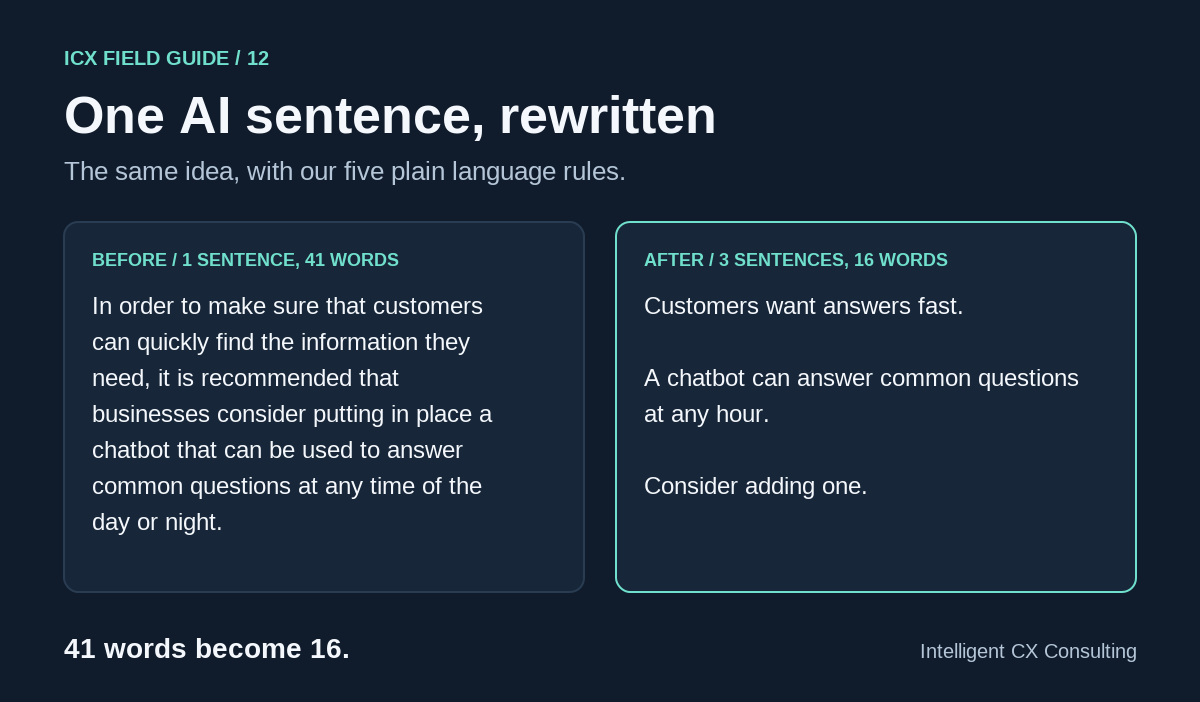
Plain Language Rules for AI Writing

Plain language rules for AI writing are limits that you set before the AI tool writes a draft. Limit each sentence to 20 words. Use active voice. Use one name for each thing. The rules come from ASD-STE100. Early studies show that AI search tools quote short passages.

AI Operations & MeasurementGuide8 min

How to QA AI Writing Without Code

You can QA AI writing without code. Write a short pass or fail rubric. Build a test set of 20 to 50 real customer questions. Check every name, number, quote, and link by hand. Log each failure and its cause in a spreadsheet. Fix the cause, then retest. A second AI can do the first pass, but a person signs off.

AI Operations & MeasurementAnalysis14 min

How Should CX Leaders Evaluate AI Agents Before Customers Do?

Sample-based quality review was built for a few human agents handling a few hundred calls a day. It cannot keep up with a fleet of AI agents handling thousands. Modern AI agent evaluation is continuous, rubric-driven, and tied directly into deployment gates. CX leaders who build it now will catch failures before customers do. Those who keep sampling will find their failures on social media.

AI Operations & MeasurementAnalysis14 min

How AI Evaluation Quietly Became the New CX Differentiator

AI evaluation is the discipline of testing whether AI systems actually behave the way you intended. Most enterprises still treat it as an engineering afterthought. In 2026 that mismatch is the leading reason agent rollouts stall and governance reviews fail. Here is what real eval looks like and why CX leaders own a bigger share of it than they think.