← The Field Journal

Practice area

Conversation & Agent Design

18 articles · Updated August 23, 2026
Conversation & Agent DesignAnalysis6 min

What Is Intent Architecture in Conversation Design?

Intent architecture is the structured map of everything a conversational AI is meant to handle. It groups what customers actually say into intents, links each intent to an action and a handoff, and adds fallback paths for the unexpected. Good intent architecture is what makes a bot resolve issues instead of guessing.

Conversation & Agent DesignAnalysis5 min

The Conversational AI Maturity Model

A conversational AI maturity model maps where your system sits on the path from rule-based bots to adaptive, governed AI. It names five stages: Scripted, Assisted, Grounded, Orchestrated, and Adaptive. It is not a vendor checklist. It is a way to see the one trap stalling your current stage and the single change that moves you to the next.

Conversation & Agent DesignAnalysis5 min

When Should an AI Answer, Ask, or Hand Off? A Decision Guide

On every turn, an AI assistant should pick one of seven moves: answer, ask, verify, repair, stop, escalate, or hand off. The move it picks shapes the whole experience. This guide gives a plain trigger for each one, so a bot acts well when it is unsure, limited, or asked to do something risky.

Conversation & Agent DesignAnalysis14 min

What Is Loop Engineering and Why Should You Learn It Now?

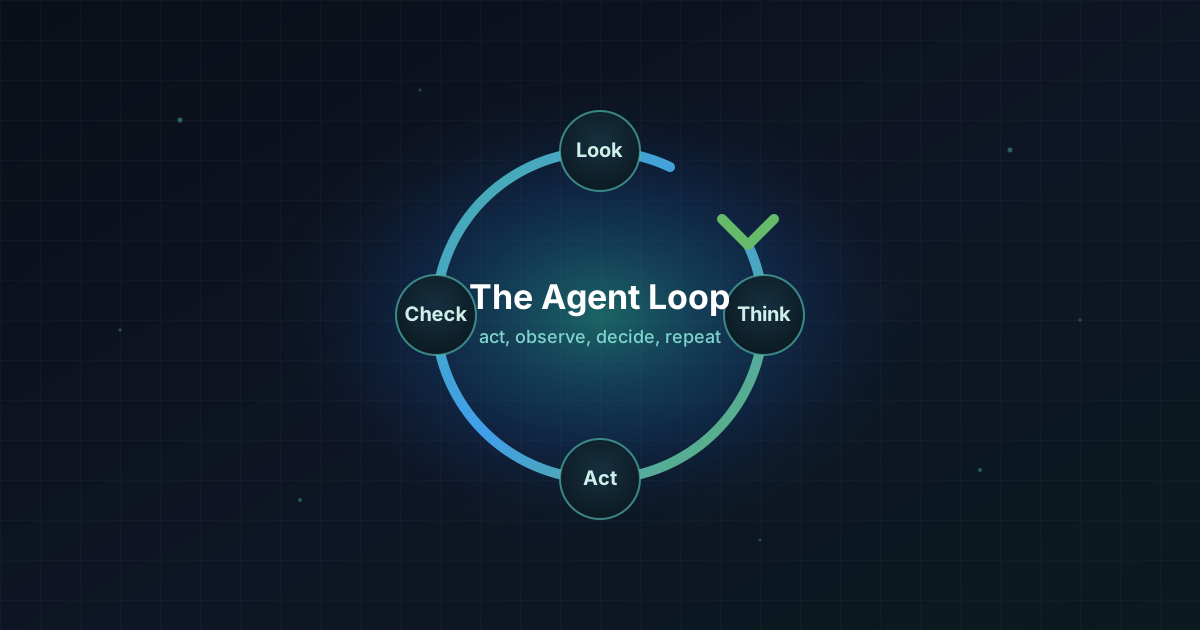
Loop engineering is the practice of designing AI agents that act, observe the result, decide what to do next, and repeat until a real goal is met. It is the skill replacing one-shot prompting. This guide explains the agent loop in plain words, shows real examples, and maps the new jobs it is creating.

Conversation & Agent DesignAnalysis5 min

How to Choose Your Chatbot's Brain (Rule-Based, LLM, or Hybrid)

A chatbot can run on rules, on a large language model, or on a hybrid of both. The right choice depends on the real system, not the demo. This guide shows how to decide per intent using six tests: determinism, compliance, latency, channel, memory, and backend access. Most strong systems are hybrid.

Conversation & Agent DesignAnalysis14 min

When Do Multiple AI Agents Beat a Single Agent?

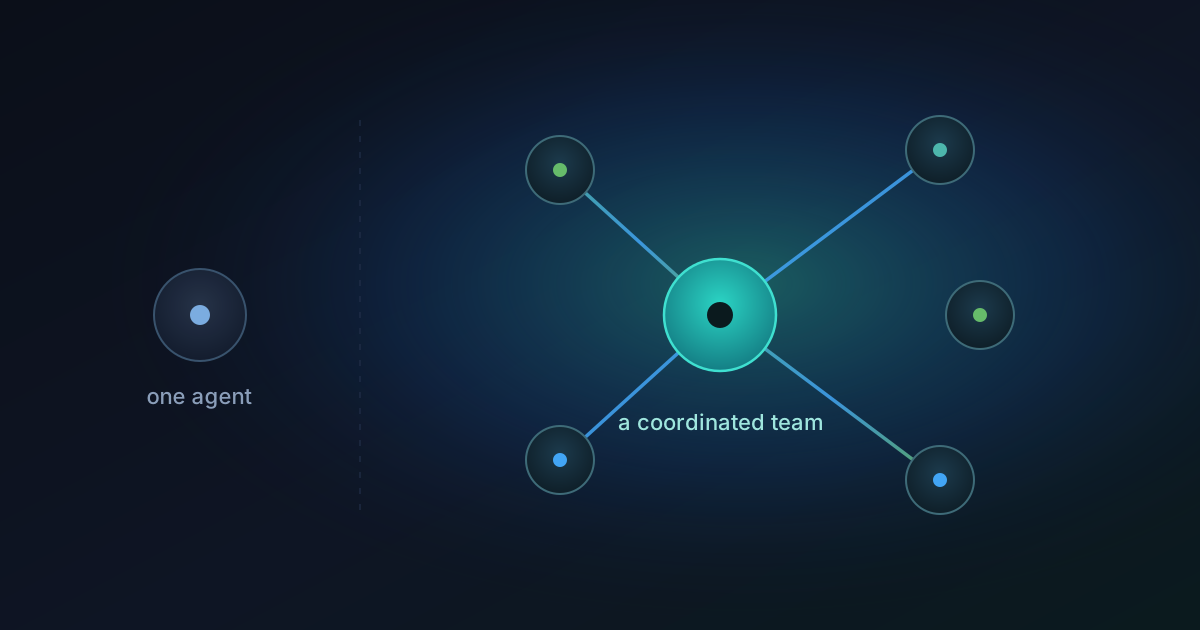
In June 2025, two leading AI teams gave opposite advice on multi-agent systems. Anthropic showed many agents beating one by 90 percent on research tasks, at about fifteen times the token cost. Cognition warned that splitting work across agents breaks context and creates fragile systems. For enterprise CX leaders, the real question is not how to coordinate agents but whether to, and what to build first.

Conversation & Agent DesignAnalysis6 min

How Prompt Engineering Is Becoming Prompt Systems in 2026

Enterprise teams are moving past individual prompts toward prompt systems: versioned, tested libraries of prompts treated as production infrastructure. In 2026, 45 percent of organizations plan to scale generative AI to production. The top blockers are guardrails (76 percent) and data readiness (62 percent). Prompt systems address both. Prompt engineering by itself does not scale. Prompt systems do.

Conversation & Agent DesignAnalysis10 min

How to Design an AI Persona That Builds Customer Trust

AI persona design is the practice of giving a chatbot a coherent character (name, voice, behavior, emotional range) that builds customer trust. A real persona is more than an avatar and a name. It is four elements working together: identity, voice, behavior, and emotional range, encoded into the system prompt and tested before launch.

Conversation & Agent DesignAnalysis9 min

The Science of Why AI Gets Politeness Wrong in Chatbots

AI chatbots routinely get politeness wrong. Too polite feels fake and slow. Too direct feels rude and untrustworthy. The fix comes from Brown and Levinson's politeness theory: every conversation involves face-threatening acts (asking for information, refusing, correcting), and good design calibrates politeness to the stakes of each act. Most chatbots hedge too much on low-stakes turns and not enough on high-stakes ones.

Conversation & Agent DesignAnalysis9 min

Your Chatbot Doesn't Have an AI Problem. It Has a Language Problem.

Most failing chatbots have capable models, reputable platforms, and working integrations. Customers still complain. The reason is a language problem, not an AI problem. The bot misses pragmatics (what people mean versus what they say), discourse rules (how turns connect), and conversational repair (how to fix breakdowns). The fix is conversation design, not a new model.

Conversation & Agent DesignAnalysis9 min

The 5 Conversational Patterns That Make Users Rage-Quit Your Chatbot

Five conversational patterns cause users to rage-quit chatbots: the dead-end response (no path forward), false confidence (sounds sure but wrong), context blindness (forgets what was said two turns ago), hostile politeness (over-formal refusals), and circular escalation (asks for the same info repeatedly). Each pattern shows up in support data and is fixable in conversation design, not in the model.

Conversation & Agent DesignAnalysis7 min

How to Design Conversational AI Fallback Flows

A fallback flow is the design layer in a chatbot or voice agent that handles everything outside the happy path: ambiguous input, out-of-scope requests, low-confidence intents, and conversation breakdowns. Three core triggers fire fallback: low intent confidence, missing required data, and explicit user frustration. Well-designed fallback flows are the difference between trust and abandonment.

Conversation & Agent DesignAnalysis8 min

The Parts of Your AI Experience You Cannot See Are the Parts That Matter Most

Real AI chatbot performance lives in invisible layers, not in the visible chat window. Five hidden layers shape every response: the system prompt, the knowledge base structure, the escalation logic, the formatting rules, and the conversation memory model. Most teams optimize the visible chat. Performance gains come from fixing the layers underneath.

Conversation & Agent DesignAnalysis8 min

How Your AI Should Handle an Angry Customer (Hint: Not Like a Human Would)

When customers are angry, AI that mimics human empathy often makes things worse. 'I understand your frustration' from a chatbot reads as performative and slows down the resolution. The better pattern: acknowledge the situation briefly, name the next concrete step, and remove obstacles. Four emotional moments deserve specific design: high frustration, fear, urgency, and grief.

Conversation & Agent DesignAnalysis9 min

A Conversation Designer's Guide to the Moment AI Gets It Wrong

Every AI chatbot will get something wrong. The real question is what happens next. Three failure types need explicit design: misunderstanding (the AI parsed the input wrong), low confidence (the AI is not sure of the answer), and out-of-scope (the AI cannot help with this kind of request at all). Each failure type has a different recovery pattern. Trust depends on getting these right.

Conversation & Agent DesignAnalysis6 min

What Is Prompt Engineering? A Practical Guide for Enterprise Teams

Prompt engineering is the practice of designing, testing, and optimizing the instructions given to large language models (LLMs) so they produce reliable, accurate, and safe outputs in production. It is not the same as writing good chatbot questions. Production prompt engineering uses system prompts, few-shot examples, guardrails, and evaluation sets.

Conversation & Agent DesignAnalysis7 min

7 Prompt Engineering Techniques That Actually Work in Production

Seven prompt engineering techniques work consistently across enterprise AI deployments: structured system prompts with clear role definition, few-shot examples covering edge cases, chain-of-thought for complex reasoning, retrieval-augmented generation, guardrails and content filters, output validation, and continuous evaluation. ICX uses all seven in client work.

Conversation & Agent DesignAnalysis6 min

Can AI Chatbots Actually Help Small Businesses? An Honest Assessment

AI chatbots can transform small business customer engagement, but only under the right conditions. They work when the use case is high-volume, repeatable, and supported by clear content (FAQs, hours, pricing). They fail when content is missing, the use case is too complex, or the chatbot is set up to deflect rather than resolve. Start with one well-defined use case.