The ICX Blog

The ICX blog covers conversational AI, prompt engineering, and CX strategy. It is written for teams that build AI customer service.

Browse by practice

Five paths through the field

Each topic matches a real choice CX and AI teams face in their work.

New to ICX?

Start here

These three articles show how to judge and improve an AI customer experience.

Conversation & Agent DesignAnalysis5 min

The Conversational AI Maturity Model

A conversational AI maturity model maps where your system sits on the path from rule-based bots to adaptive, governed AI. It names five stages: Scripted, Assisted, Grounded, Orchestrated, and Adaptive. It is not a vendor checklist. It is a way to see the one trap stalling your current stage and the single change that moves you to the next.

Implementation & CXGuide9 min

How to Audit Your AI Customer Experience in 30 Minutes

The 30-minute AI CX audit is a five-dimension framework that finds what is actually broken in a chatbot. Spend 5 minutes on setup. 15 minutes having real conversations as if you were a customer. 10 minutes scoring the five dimensions: language quality, error handling, escalation design, trust signals, and resolution. Dashboards miss most of what this audit catches.

AI Strategy & GovernanceAnalysis6 min

What Is Intelligent CX? How AI Is Transforming Customer Experience

Intelligent CX combines conversational AI, prompt engineering, and CX strategy to design customer experiences that resolve issues, build trust, and scale across channels. It is not a new technology category. It is a discipline that treats language, escalation, and measurement as design problems instead of vendor configuration tasks.

The latest

Recent analysis

Showing 16–30 of 76 articles

AI Strategy & GovernanceAnalysis13 min

Why AI Literacy Has Become the Enterprise Workforce Risk No One Is Measuring Yet

AI literacy is now the workforce risk most enterprises are not tracking. The EU AI Act made it a compliance requirement in February 2025. Generic training programs do not deliver it. Real literacy is role-specific, hands-on, and continuous. CX, governance, and HR leaders need to build it now or rebuild after the audit.

AI Strategy & GovernanceAnalysis15 min

Claude Tag, MCP Authorization, and Sandboxes in Anthropic's June 2026 Enterprise Stack

Anthropic shipped three pieces of enterprise AI infrastructure between May and June 2026. Claude Tag puts a persistent agent inside Slack. Enterprise-Managed Authorization provisions MCP connectors through Okta. Self-hosted sandboxes keep agent execution inside the customer perimeter. Together they reframe AI from a chat tool into a governed teammate with identity, scope, and a full audit trail.

Conversation & Agent DesignAnalysis14 min

When Do Multiple AI Agents Beat a Single Agent?

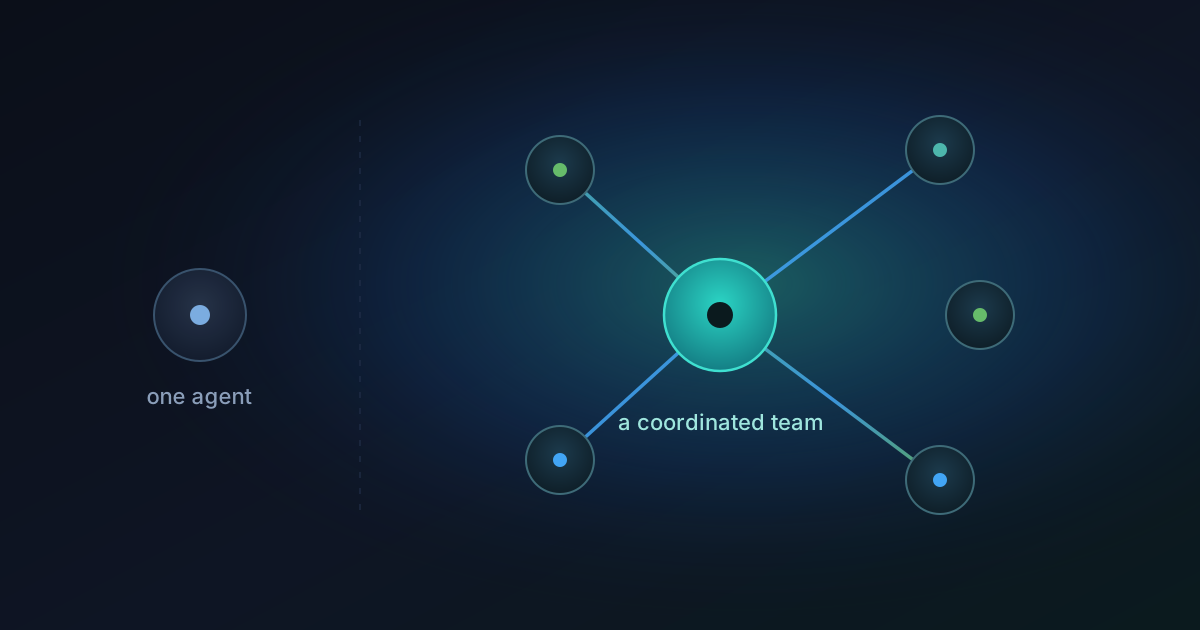
In June 2025, two leading AI teams gave opposite advice on multi-agent systems. Anthropic showed many agents beating one by 90 percent on research tasks, at about fifteen times the token cost. Cognition warned that splitting work across agents breaks context and creates fragile systems. For enterprise CX leaders, the real question is not how to coordinate agents but whether to, and what to build first.

AI Strategy & GovernanceAnalysis15 min

What Anthropic's Dreaming Agents Mean for Enterprise CX

On May 6, 2026, Anthropic gave Claude Managed Agents three new abilities. Dreaming lets agents learn from past sessions. Outcomes grades every output against a rubric. Multiagent Orchestration runs up to 20 specialist agents in parallel. Together they target drift, quality at scale, and complex work, and they raise fresh governance questions for CX leaders.

AI Strategy & GovernanceAnalysis18 min

Why Context Engineering Is the Infrastructure Enterprise AI Has Been Missing

Context engineering is the discipline of designing what information an AI system receives, how it is structured, and when it enters the model's working memory. Gartner named it the breakout AI capability of 2026 and predicts context improvements will enhance agentic AI accuracy by 30%. For CX leaders, context architecture determines whether AI investments deliver customer trust or operational failure.

AI Strategy & GovernanceAnalysis14 min

Anthropic's $1.5B Move From Model Maker to Consultant

Anthropic launched a $1.5B enterprise AI services firm with Blackstone, Hellman & Friedman, and Goldman Sachs in May 2026 to embed engineers inside companies and redesign workflows around Claude. For CX leaders, the move carries a specific message. The AI bottleneck has moved from model capability to deployment expertise. The new firm covers technical integration. It does not cover conversation design, content engineering, or experience measurement: the layers that determine whether an AI deployment improves customer experience or degrades it.

AI Strategy & GovernanceAnalysis16 min

The AI Control Gap and Why Leaders Answer for AI They Can't Control

Two-thirds of CIOs and CTOs are accountable for AI systems they don't fully control, per a June 2026 IBM study of 2,000 executives. Seventy percent say business teams deploy AI faster than IT can track. Organizations embedding control deploy 16 times more agents with 25 percent fewer incidents than those relying on manual governance. The AI Control Gap is structural and solvable, but only by treating governance as a deployment prerequisite, not a follow-on project.

AI Strategy & GovernanceAnalysis12 min

ISO 42001 and AI Agent Readiness for Scaling Enterprise AI

Buying AI tools is not the same as being ready for AI agents. Most organizations stall somewhere between pilot and scale, not because the technology failed, but because governance, data, and measurement weren't in place before deployment. Only 21 percent of enterprises have mature agentic AI governance while 42 percent are already running it in production. That gap is where CX programs break down.

Implementation & CXGuide10 min

Why Clear Flows Still Fail to Drive Action

A conversational flow can be clear, well structured, and technically correct and still fail to move customers to act. Behavior design adds a second layer to conversation design: motivation, ability, prompt timing, and friction. The Fogg model (Behavior = Motivation, Ability, Prompt) and ethical friction reduction explain why and how to fix it.

Implementation & CXGuide11 min

How to Test Conversational AI Experiences

Testing a conversational AI means validating logic before automating it, then measuring real behavior after launch. Use Wizard of Oz testing pre-build, an alpha-beta-scale sequence, a four-layer Bot Scorecard, and transcript review. Dashboards show where to look. Transcripts tell you what to redesign. Maturity begins after launch.

AI Strategy & GovernanceNews9 min

KPMG Just Gave 276,000 People Claude. The Real Lesson Isn't the Rollout.

On May 19, 2026, KPMG and Anthropic announced a global alliance that puts Claude in front of all 276,000+ KPMG employees and embeds it in client work across tax, legal, and private equity. The headline is the scale. The real lesson is what KPMG paired it with: research on the human judgment that turns AI access into actual value.

AI Strategy & GovernanceNews7 min

Project Glasswing Is a Cybersecurity Story. A Conversation Designer Reads It Differently.

Project Glasswing is a new Anthropic-led effort, with partners like Amazon, Google, Microsoft, and JPMorganChase, to secure critical software using Claude Mythos Preview, a model that finds software flaws better than almost any human. Most coverage will focus on the hacking. This opinion piece reads it through a conversation designer's eyes: the names, the framing, and what it means for any business whose AI talks to customers.

Conversation & Agent DesignAnalysis6 min

How Prompt Engineering Is Becoming Prompt Systems in 2026

Enterprise teams are moving past individual prompts toward prompt systems: versioned, tested libraries of prompts treated as production infrastructure. In 2026, 45 percent of organizations plan to scale generative AI to production. The top blockers are guardrails (76 percent) and data readiness (62 percent). Prompt systems address both. Prompt engineering by itself does not scale. Prompt systems do.

Implementation & CXGuide9 min

How to Build a Knowledge Base Your AI Can Actually Use

An AI-ready knowledge base is structured for retrieval, not for humans skimming a help center. The foundation is the atomic chunk: a single self-contained answer 50-150 words long with clear metadata. Most enterprise knowledge bases mix long articles, outdated content, and ambiguous topics. AI cannot reliably retrieve from that. Reform the content before you blame the model.

Conversation & Agent DesignAnalysis10 min

How to Design an AI Persona That Builds Customer Trust

AI persona design is the practice of giving a chatbot a coherent character (name, voice, behavior, emotional range) that builds customer trust. A real persona is more than an avatar and a name. It is four elements working together: identity, voice, behavior, and emotional range, encoded into the system prompt and tested before launch.